
How to Stop Rambling and Structure a Speech with a Clear Message
Without a proper structure, even the smartest of people can deliver speeches that feel messy and forgettable. The audience quickly starts wondering what the point is and where the speech is heading. But when a speech is well structured, the audience follows your argument and connects with your message.
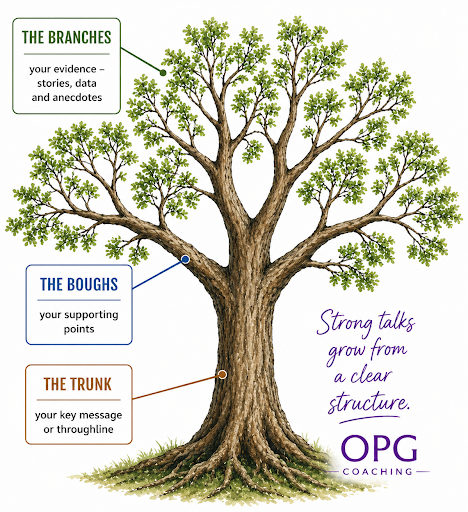
One of the simplest and most effective ways to structure a speech is to borrow a framework from nature and shape your speech like a tree. The OPG Tree Structure helps to keep you on message and allows the audience to easily follow your train of thought.
The trunk is your central message holding everything together.
The boughs are your supporting points
The branches are evidence and examples that demonstrate your points - stories, anecdotes or data.
The Trunk: Your Key Message
The trunk is the central idea holding everything together. It’s the answer to the question: “What is this speech really about?”. Your throughline is not your topic, it is your key message. For example, it is not ‘storytelling’ but ‘stories are more convincing than facts.’ That single idea or opinion becomes the spine of the speech. Every point and example feeds back into it.
The trunk keeps your speech focused. If something does not support the central message, it probably does not belong in this particular speech.
The Boughs: Your Main Points
The boughs are your main points, your core ideas that support your key message.
For example, if your trunk is: ‘Stories are more convincing than facts.’
Your boughs might be:
Stories are more memorable
Stories create emotional connection
Stories persuade because people make decisions based on emotions
Each bough explores a different angle of the central message. The points you present should help to convince your audience of your central thesis.
The Branches: Stories, Evidence and Data
This is where your speech comes alive. The branches are the proof that demonstrates your points: stories, anecdotes, statistics, research and examples. Every branch should illustrate a bough, and every bough should demonstrate the trunk. That is what keeps a speech focused, persuasive and easy to follow.
For example, if your third bough is: ‘Stories persuade because people make decisions based on emotions’ you now need branches that prove that point.
Branch A: Demonstrative Story
Two animal shelters run fundraising campaigns. One shares pages of statistics about abandoned dogs. The other simply shares a photograph and story about a frightened rescue dog called Max who had been returned three times before finally finding a home. People overwhelmingly donate to the shelter who shared Max’s story, because people emotionally connect to one personal story far more than abstract numbers.
Branch B: Scientific Substantiation
Psychologist Paul Slovic found that people are far more likely to act compassionately towards one identifiable individual than towards large groups described statistically - a phenomenon sometimes referred to as “psychic numbing”.
Branch C: Scientific Substantiation
Nobel Prize-winning psychologist Daniel Kahneman showed that humans often make decisions based on emotions and justify them with logic afterwards.

Why This Structure Works
You can’t go off course if you use this structure, because everything that you say helps to build the credibility of your central argument.This is why the Tree Structure is so effective. When I deliver communication training in London, I use this method to help professionals present ideas clearly and persuasively.
Before You Write Your Next Speech
Start by mind mapping everything you could possibly want to say. When I teach my online public speaking course, I encourage clients to get all of their ideas out first without worrying whether they deserve a place in the speech. Then I ask them to take a piece of paper and draw a tree, adding only the ideas that deserve to be in the speech.
Start with the trunk: the core message you want the audience to leave with. Then build the boughs: the major supporting points strengthening that central message. Finally, add the branches, the evidence and examples that back up your points, and allow your audience to connect with your message both intellectually and emotionally.
This exercise is also useful because it stops you trying to say everything you know. Instead, it forces you to focus only on what the audience needs to hear in order to understand and believe your central message.
Checking your speech against the Tree Structure
As a public speaking coach in London, I always carry some plain paper with me. If my client’s speech feels rambling or unfocused, I will get out a sheet of paper and see if we can map their speech onto a tree.
Very quickly, you can see where the problem is.
Sometimes there are too many boughs. If someone has more than five major points, the audience is unlikely to retain them all.
Sometimes the branches are not actually connected to any boughs. Their data doesn’t back up their points.
Sometimes the boughs are not actually connected to the trunk. The speaker has several interesting points, but they are not building one central argument.
Sometimes there is no trunk at all. No clear throughline tying the speech together. The audience will hear a lot of information but there is no clear sense of what they are meant to take away.
This is why the Tree Structure is so useful, not just before writing a talk but for checking it after it is written. Once a draft exists, drawing it out visually onto a tree makes the weaknesses obvious. You can immediately see whether the speech is focused, persuasive and easy for an audience to follow. I find OPG Coaching clients really enjoy the Tree Structure because it is simple to use and it means their can visualise their speech in its entirety.
A great speech is not about saying more. It is about saying one thing clearly enough that people remember it.